Sunday, April 9, 2017

Waiting for the Liberator


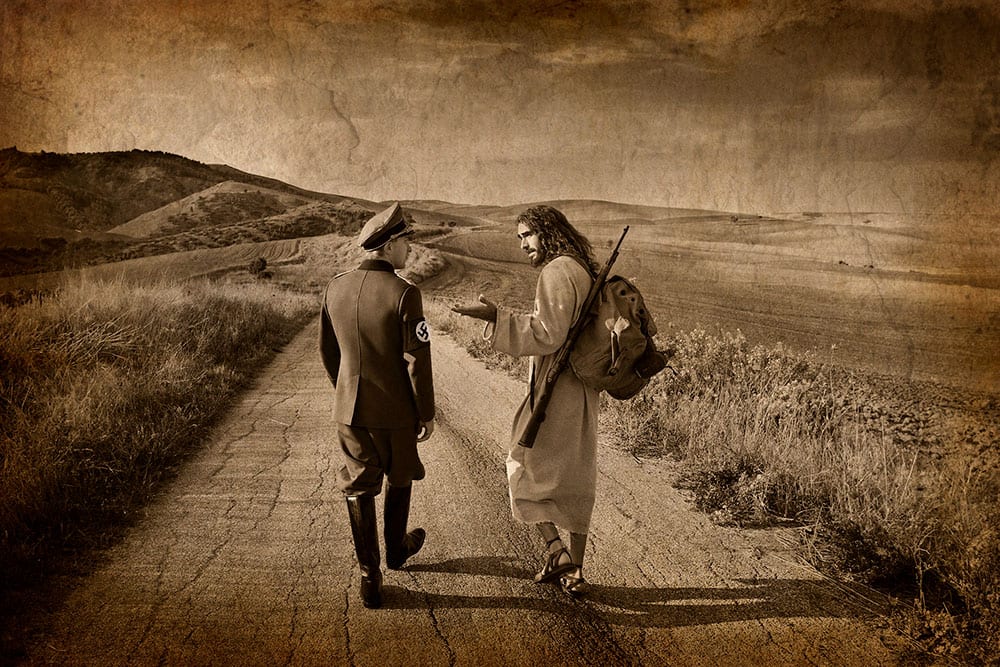
Make yourself comfortable, and give yourself time to ponder the images and questions here. A meditation on Matthew 21:1-11 for Palm Sunday, 2017. You can also listen here.
One day, he will come. He will enter the city in triumph, and free the people from the occupying forces. Maybe he’ll be wearing a thick leather jerkin, and riding a battle horse. Maybe he’ll have a sword at his side. Maybe he’ll bring an army of rebels, ready to raise hell and throw out the oppressors: self-serving politicians, rapacious business owners, corrupt bureaucrats, mercenary soldiers, powerful predators, those who place profits before people, those who stay silent in the face of violence. Keep reading here.

Wednesday, March 29, 2017

In praise of chat

I have a couple weeks off, plus we finally have a separate website for the church: it's time to reclaim this site as my blog. And so I’m trying to remember what I like to write about when I don’t have sermons or essays due. As I rootled around the files, I found a Psalm I wrote awhile back which really resonated, perhaps because, with fewer friends and a husband away half the time, life in this new city can be a bit lonely. A slightly different version first appeared in Zadok Perspectives No. 129 (December 2015).
**
How right it is to sit with friend and cup of tea.
How precious to see a hint of glee in her eye, or glint of tears,
or small frown as she encounters new ideas.
How fine to hear voices joined in laughter!
How healing the gentle silence which falls,
grants grace, after story strange and sad.
How good to chat as children roam house, raid biscuit tin;
as teens and husbands wander in,
settle at table, join the exchange.
Praise the One who gives tongues to talk,
minds to think, wit to play!
Praise the One from whom stories flow,
blessings grow, and songs take flight!
Whose words wrought worlds,
whose love begets love,
who seeks conversation between us, and Above.

Sunday, March 19, 2017

The King of Hearts meets the Queen of Tarts


You can listen to this reflection here.

She has three strikes against her. One, she is female. No religiously correct man would let himself be caught alone with a strange woman; he certainly wouldn’t be chatting with her. Two, she is a Samaritan. Jews and Samaritans don’t mix; and they certainly don’t eat or drink together. Three, she’s had five husbands, and now she’s with a man she is not even married to. She’s hot stuff; her reputation is shot. Other women go to the well at dawn and at dusk. They go in groups, to stay safe; and as they walk and draw water, they share the news of the day. She goes at noon. She avoids the other women: the stares and the gossip, the snippy comments and the icy silences. She goes alone. 

Sunday, March 12, 2017

Angry judge, or the face of love? God revealed on the mountaintop


(You can listen to this reflection here.)

How we hear stories about Jesus depends very much on our image of God. I was thinking about this because, in our conversation last week about the prayers of confession, several people said that they felt, or had been taught, that God was just waiting to judge them. The image of God as a harsh and violent judge is pervasive, and it shapes us. Like the disciples who go with Jesus up the mountain, many of us hold onto this idea, even although it may not be quite right. For this image of God comes, in part, from an older story, a story which predates Jesus. A story that also involves a mountain. Let me tell it to you:

Sunday, February 26, 2017

Do Not Worry: Stepping through an ethical minefield with Jesus

Do not worry about your food! Payment in kind.
It may not buy school uniforms, but it does feed the family.
Before we moved to Warrnambool, we lived in an area of Melbourne which was a hive of ethical activity. Our clothes were locally made or from the op shop. We rode our bikes to buy direct trade coffee, then ducked into organic wholefoods for some ethical groceries. What we couldn’t buy there, we’d get at the IGA, after checking each company against our sustainable supermarket guide. We grew our greens and herbs; experimented with Community Supported Agriculture, but got sick of all those potatoes; so opted into a local veggie box instead. Our honey came from local hives; our socks were made in Brunswick; we purchased gifts from local artisans; our furniture was second hand. Even our house renovation appeared in a green architecture magazine. There were times when we were so ethical, it makes me sick. Of course, we lived this way because we were trying to be followers of Jesus—and because we were surrounded by people also seeking to live more sustainably, the critical mass made it easy. But every now and then, or maybe quite a lot, I’d feel someone, probably me, rolling her eyes because a coffee wasn’t fair, or a chair was from IKEA, or the eggs were from battery hens—and I’d wonder if I’d missed the point.

Sunday, February 19, 2017

Love who?!

The Second Mile. This incredibly confronting image
was found at journeyswiththemessiah.org
Once upon a time, I was sitting in a class at the theological college when the concept of ‘love your enemy’ came up. The pastor of a large church became annoyed and said, “I’ve got no idea why we waste time talking about this. We’re Christians—we have no enemies!” His comment revealed what is actually a fairly common idea: Those of us who are not actively oppressed by a violent regime, and who work very hard to be nice, often think we love everyone. But is this true? And can we throw the whole idea of loving our enemy out?

Wednesday, February 15, 2017

What Happens Next?

A reflection on Matthew 5:27-37, by Joel Rothman.
Given to Sanctuary, 12 February 2017.

***

When I was almost 12 years old I discovered a big thick novel called Magician, and from the moment I picked it up I couldn’t put it down. For 800 pages I was engrossed in a different world, a world of dragons and magic, fear and bravery, love and loss, and an epic adventure through a world very different to our own…And finally the threads of the story were tied together in a grand conclusion. From that time I was hooked. I read book after book, each opening up a different world. Each was similar to the last in many respects, and yet at the same time radically new. After Magician I was lost in The Wheel of Time, and Game of Thrones, the Shannara Chronicles and Lord of the Rings. Many of those books have now been made into movies or high-budget TV series, and you can see it on the screen. But back then I saw it all in my head.

More recently I’ve been exploring the idea of reading scripture the way I read these novels. What if we read scripture as a story? Can we see how this passage follows from the one before? Can we see how the narrative threads lead into the next? And the dialogues too. What if they aren’t just independent, philosophical dissertations – what if we read them as part of the story? Part of the dialogue between the characters in the story?
Related Posts Plugin for WordPress, Blogger...