A city of joy, its people a delight: this is what God promises through the prophet Isaiah. Sounds wonderful! So, what are the elements of this joyful city? First, says Isaiah, health and wellbeing ...
A city of joy, its people a delight: this is what God promises through the prophet Isaiah. Sounds wonderful! So, what are the elements of this joyful city? First, says Isaiah, health and wellbeing ...

 |
| Do not worry about your food! Payment in kind. It may not buy school uniforms, but it does feed the family. |


Someone we love is ill with depression. He also suffers from social anxiety and struggles to leave the house. When our kids ask why he doesn’t come to dinner anymore, we try to be matter-of-fact. We explain that he is not well. We explain that he has something called depression, which has various effects; among them, it is very hard for him to spend time with other people. But for all our matter-of-factness with the kids, we adults don’t feel matter-of-fact at all.
Because it’s been a long, long absence and I am beginning to realise just how much our relationship has changed. We used to invite him to things; but I realise that now we just invite his partner, and mention that he is invited too. We used to send him texts; but now, we rarely do. We used to ask him to do things, but now we are afraid of asking too much, and no longer make the requests. It’s been a gradual shift, never deliberate or intentional; but I am beginning to realise just how much we participate in and reinforce the social exclusion triggered by the illness.
And for all our tip-toeing, and wondering questions, and reading, and delicacy on his behalf, he is of course still ill. We never see him, and we miss him. We never talk, his burdens and gifts are never shared, and we still don’t know what, if anything, we can do to help.
Recently, it was my daughter’s eleventh birthday. A week before her birthday, she sought out this person’s partner and asked whether he could bake her birthday cake. When I found out, I went to my daughter and asked her about it. She hadn’t seen him for many months, and so I wondered why she had asked. ‘Well,’ she said, ‘I thought it would be good for him to be included in my birthday. And maybe to know that he can give something to me, even if his illness means he can’t come to the party. Is that okay? Do you mind?’
Tears came to my eyes. I gave her a huge hug, and I told her that she was one of the wisest and most generous people I know, adult or child. She had stepped right across an invisible, toxic social line just by asking for a small, good thing; and I recalled the ancient text: ‘sometimes a little child shall lead them.’
Through his partner, our friend agreed to my daughter’s request. He found a recipe, his partner did the shopping, and he baked the cake. His partner brought the cake to the birthday party, and we all sang Happy Birthday. We missed our friend, and wished he could have been there to sing along with us – and yet, in some ways, he was. For in our midst, at the centre of our singing, sat the cake that he had made, that precious thing my daughter had both given and received: a blessing.
And it was delicious.
**
The title of this post comes from a study by Elise Boulding, who asked young people how they had nurtured adults in their families while they themselves were children. The article is not easy to find, but if you want to go hunting here are the details: Boulding, E. (1980). 'The nurture of adults by children in family settings'. In H. Z. Lopata (Ed.), Research in the Interweave of Social Roles: Women and Men (Vol. 1, pp. 167-189). Greenwich, CT: JAI Press.
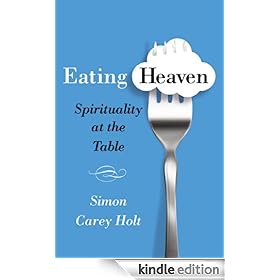
I may be biased, but my friend Simon wrote a terrific book last year, Eating Heaven. And I loved it. I read it very slowly and savoured every bite.
Each chapter focusses on one table: the kitchen table, the backyard table, the café table, the restaurant table, right up to the table of communion. And each chapter has stories, interviews, history and reflections on that table: eating with mum and dad in the kitchen, sharing a meal with marginalised men and women at a free lunch, having a coffee with a chef between shifts, and so on. Each chapter then ends with a recipe reflecting the type of eating that happens at that particular table.
The book is layered and rich, reflecting Simon’s background as trained chef, sociologist, theologian, and Baptist minister. It also reflects his love of Melbourne in the descriptions of laneway cafés and linen-topped restaurant tables; the juxtaposition of social inclusion and fancy pastries at one downtown church; and the transformative power of eating together in a multicultural city. Whether reminiscing over crowded kitchen tables or backyard barbecues, or savouring the perfect café latte or fancy restaurant dinner, Simon is always thoughtful. In a culture of empty food porn, his voice nourishes and refreshes. He not only enjoys the food, but also contemplates how poverty and wealth, hospitality and exclusiveness, celebration and mourning, and many other issues play out when we sit down at the table. His gentle questions and tentative suggestions are always thought-provoking.
More, they have an effect. Eating together is central to being human; and Eating Heaven reminds us of this gift. In my own household, reading it has triggered a couple of changes. For one, we have returned to a more intentional saying of grace. Despite trying various things over the years, grace had become a rushed magic formula that one or another kid would gabble as they reached for the serving spoon. It was worse than if we had not said it at all. But after reading this book, I have asked that we return to saying grace properly. Now we move between a candle and a responsive prayer; a minute’s silence before the meal; or held hands and a song depending on the mood – and we are loving this grateful pause at the end of the day, this moment of being together before we eat our dinner.
Eating Heaven has also recalled us to simple acts of hospitality, which we largely left behind in the maelstrom of having a third child. A few years on, we’re again able to make time for a coffee with friends, or invite others to eat with us in our home; and Eating Heaven has been a catalyst for thinking about why we eat together and how to do it well.
The stories, reflections and very good questions make this a book to savour, and slowly digest. Thank you, Simon.

It’s my birthday, and has it been a busy year! My third child is finally at school. I am working part time and studying part time and running a household and doing all the things that people my age do. But today, being my birthday, it is time to take stock and reflect.
Yesterday, I met with my professional supervisor. ‘What are you going to give yourself for your birthday?’ she asked. ‘Think about a gift you can give, from deep in yourself to yourself, and tell me about it next time.’
This morning I woke up and knew what it would be: permission to stop striving. There’s nothing wrong with working hard, but there’s sometimes wrong with endless striving. I get up in the morning, organise three kids out the door and ride them to school. Then I turn around and ride home. I work and study for five or six hours, stopping only to eat and pee, then hop back on the bike and pick the kids up from school. We cycle home, I feed them, then I bring the washing in, tidy the back table, organise piano practice, listen to readers, cook dinner, and do all the things every parent does every night of the week. My partner comes home and asks me how my day was, and I say, ‘I feel like I haven’t done anything.’ He asks me what I have actually done, and I say things like, ‘Well, I did a first draft of a book review for a journal, and wrote up the minutes of a meeting and made a heap of phone calls and met with my supervisor and sorted three loads of washing and cooked dinner and actually, there was a bit there after all, wasn’t there?’. He looks at me and smiles, yes.
Because I work in a church, I always work on Sunday evenings; and because I’m often preaching, I’ll write for a few hours many Saturdays, too. Because the kids are at school all week, I feel like I can’t ‘waste’ that time, and so I also work Monday to Friday. Because Easter is a big work week, with services on Thursday, Friday and Saturday night and a gathering on Sunday morning, and because my husband had to work over the school holidays, I didn’t get a break these Easter holidays from either my work or the kids. And so in fact I have worked for some hours at least of very many days in a row; and also been busy with children.
All things considered, I’m hardly twiddling my thumbs. Yet despite this activity, I often feel like I’m not doing enough. There are so many ‘shoulds’ and ‘oughts’ that I find it hard to do the things that aren’t at the top of the list – like write a blog post, for example.
But today is my birthday, and I have given myself permission to stop striving. So I took the kids to school and went to the canteen. I usually work there for an hour on Tuesdays, but today, because I was not striving, I stayed longer. I sat on the deck with other parents and chatted over coffee about trees and gardens. Then I headed into the kitchen, where I made spinach and cheese pastries, and learned how to roll pastry like an empanada. I talked with my friend who runs the canteen: about parenting and housework, meditation and the meaning of life. She gave me a new cookbook, written by a friend of hers. In a quiet moment, we flicked through it and I was so inspired that I went home via the shops to buy the ingredients for a warming soup.
Because I wasn’t striving, I called a friend and had a birthday chat. Then, feeling decadent, I ate my birthday chocolate as an entrée to my vegetable lunch. I thought of ten jobs I should do, but I stood at the window and gazed at the pear tree, instead. The tree is turning from green to red, and the top is crowned in blazing leaves. I remembered a post I wrote years ago, about another pear tree, and dug it out and read it. And then, because I wasn’t striving, I decided to write this.
Happy birthday.
And to all you gardeners out there, yes, the photograph is of a crab apple leaf; the red leaves on the pear tree are too high for a good photo just yet! And this book is my most excellent birthday present - thanks Kris!

Studying, school holidays, blah blah blah: sadly, I have nothing new for the blog. Instead, here's a piece I wrote for Zadok Perspectives No. 117. It was first published in the summer of 2013. The picture shows a selection of this week's gleaned fruit: persimmons, grapefruit, lemons, and cumquats. Another two kilos of grapefruit are in the veggie crisper. More than enough, even for grapefruit-loving me!
***
As a teenager I lived in the US, and I never became accustomed to the waste so many North Americans took for granted. It was epitomised by my youth group breakfasts. A boy would pick up a donut, take a bite, and throw the rest in the trash. A minute later, he'd pick up a second donut, a different flavour perhaps, take another bite, then throw that donut out, too. It never occurred to him that there was a cost involved in the donut, bigger perhaps that the dollar someone else had paid for it; or that there was a moral duty to eat it up; and when I, an awkwardly self-righteous Australian and newcomer in their midst, raised the issue, everyone looked at me askance.
He was, of course, only mimicking a wider society where restaurant servings were often double or triple what I considered enough, and where food – and everything – was thrown out with impunity. I recently read that 40% of all food produced in the United States is discarded, and that certainly tallies with my informal observations.
Before we become too smug, however, FoodWise estimates that Australians also chuck out a great deal: 180 kilograms of food waste per person per year. And it's not just food. How often do we send clothes to the op shop because we are, quite simply, sick of them? How often do we update our technology, our furniture or our cars, for no real reason? How rarely do we use things up, or wear things out?
And how much is enough? The population issues that place so much pressure on our planet circulate around this question. How much food, and what type? Is clean drinking water enough or must we drink filtered water from plastic bottles? How many cars, computers or lounge rooms do we really need? I know many women with forty or fifty pairs of trousers; could two or three pairs suffice?
At least until recently, there has been more than enough in the world to go around as long as the rich – and anyone reading this is rich – are willing to live with less. If we learned to live with enough, rather than the gross extravagance we take as the norm, then perhaps population wouldn't be such a pressing issue.
The Christian tradition offers a challenging perspective. The early church lived out a radical fellowship in which people lived from a common purse and learned to be content with enough. To each according to their needs, from each according to their gifts: this didn't originate with Marx but with the Acts of the Apostles. Yet most of us in the Christian church, let alone our society as a whole, have moved so far from this way of life that it is seen as deeply suspect.
Perhaps, though, it is time to revisit it. I am not advocating a radical communism instituted through violence from on high; but perhaps there are ways that we can practice sharing, and practice acknowledging that we have enough. Let me give you some examples from my family's small efforts.
My family eats many gleaned foods, and little meat. We are called to stewardship which implies a careful management of that which has been entrusted to our care. Thus I prioritise 'gift' foods – grapefruit overhanging a laneway, greens found on the roadside, a box of plums from a friend's tree – over bought foods; and when I am shopping, I prioritise local, sustainable or fair foods over others. We also grow what we can in our garden: leaves, nuts, fruits, herbs and, of course, eggs.
Our clothes are mostly second hand or made from organic or recycled fibres. As for how many, I am trying to find the point of 'enough', that is, where I still need to launder very regularly but do not have an underpants crisis!
We use bikes and public transport to get around. We do have a car, which we use as little as possible; over the years, we have been involved in informal car share networks so that other friends feel less pressure to purchase cars of their own.
Most of us own big possessions that are rarely used. Years ago, I belonged to a church with a resource directory. The family-sized tent, the trailer, the food dehydrator, the holiday house – whatever people were willing to share was placed on a list for others to borrow. It not only reduced the amount of stuff everyone owned; it also raised questions. Did neighbours need a deep freeze each or could they share one? Could they share a clothes dryer? Our society's wealth means that many of us have never had to learn how to share anything much more significant that the last slice of cake, but perhaps we could look back to the early church and teach ourselves again.
It's certainly easier to share when possessions are held lightly. For example, we have dozens of wine glasses: they are an annual gift from my husband's workplace and very useful. Friends feel they can borrow them when they have a party, and if some are smashed, then so be it. We also have many books, and years ago I realised that it was better to give them away, and be delighted if they came back, than to be hung up over their return.
These are just a few simple ways we can experiment with 'enough'. Few of us are ready for, or even called to, a radical discipleship where we sell all our possessions and give what we have to the poor; but we may as well practice sharing, right now, just in case the call comes.
And I'll let you in on a secret. Once we realise we have enough, something strange happens. A life which may have seemed short of just one or two things – always one or two things – is suddenly overflowing with riches. We may own fewer items, perhaps, but we learn to be grateful for them; and we become linked into a new community by engaging in the difficult and countercultural practice of sharing. Gratitude and friendship: what more could we ask? The truth of the matter is indeed counterintuitive: 'enough' is the real pathway to abundance.
***
A few months ago, my husband and I had that rare and precious thing: the spontaneous offer of a babysitter. We decided to go out for dinner. We lucked upon the last table at a lively restaurant and shared a fantastic meal, with wine to match each course.
As the evening drew to a close, I sat there turning my glass in my hand and reflecting on how well we have eaten over the years. Before we had children, we dined out several times a week. Since then, we have visited Europe twice with young kids and eaten our way around Italy, Germany and even, surprisingly deliciously, Great Britain, while at home we buy nectarines, mangoes, avocadoes and all sorts of other foods that neither of us had much as children; they were far too expensive back then.
Flooded with gratitude, I said to my husband, “I have had so many good things to eat in my lifetime, it really wouldn’t matter if I never ate another decent meal again.”
As is the way of fate, a couple of days after I made this claim I went to a natural therapist to try and tackle years of fatigue and constant illness, and in particular the development of debilitating arthritis; and, as I wrote in last quarter’s Zadok Perspectives, I was immediately placed on a very restrictive diet for four months (no sugar, gluten, fruit, dairy, alcohol or caffeine), with the additional caution that I should strictly limit my intake of these foods for the rest of my life.
The timing was impeccable. I had just made a big claim about food; here was my opportunity to test it. In any case, I was so desperate to feel better that I quickly adopted, and have largely stuck to, the diet; but I soon found myself wondering what to do about eating with others. How would we celebrate a birthday if I couldn’t eat cake? What would we have for a friendly afternoon tea if I wasn’t eating scones? Who would come for dinner if I didn’t make dessert or pour out the wine?
Clearly, hospitality wasn’t going to work if the sweetest thing on offer was a carrot stick. On reflection, however, I realised that the restrictive diet was only about eating. I could still cook whatever I liked; whether or not I ate the food was a separate issue. So I stuck to my usual pattern of whipping up banana loaves on Mondays, when Grandpa comes to visit; baking cakes on birthdays and grumpy days; and making cookies to take to friends.
I thought I might resent cooking food that I could not eat myself, but I also thought it would be a good test of my generosity. To my surprise, however, far from resenting the situation, I have discovered that I still love to make special things. Previously, I hadn’t realised just how much the act of preparing and offering food gives me pleasure; I had thought a great deal of the pleasure was in the eating. But seeing friends and family savour and relish what I have cooked, and watching them grow expansive after the second glass of wine, makes me tremendously happy; and, as my taste buds shift to a more savoury palate, my desire to eat the food myself grows less and less.
It’s the opposite of most advertising messages, which encourage us to satisfy ourselves and make ourselves happy because, we’re told, we’re worth it. Instead, as I chomp my way through yet another handful of nuts or celery sticks, or perhaps crunch into some rice crackers which are, I admit, growing rather tiresome, I recall that others are worth it; and in seeing them respond to the loving care that is communicated through a slice of cake or a basket of scones or perhaps a pot of soup I cannot eat, I find myself expansively happy and deeply satisfied, having never even taken a bite.
PS - For those who are curious, a year or so later I am now drinking wine (you gotta live) and caffeine (which helped me limp through the debilitating fatigue I experienced during a month of eating gluten prior to a test for coeliac disease). I aim to wean myself off caffeine again when things have settled down. I still eat very little cane sugar, fruit, gluten and cow's milk.
***
To read more, click on the embedded link below and flick to the back; or click here and follow the link to download the issue to your iPad.

Very belatedly for one who is interested in local food, I have finally picked up The 100-Mile Diet: A Year of Local Eating by Alisa Smith and JB McKinnon (published in the US under the title, Plenty). I admit I avoided it for a long time. I had already read a book on similar themes, Animal, Vegetable, Miracle: Our Year of Seasonal Eating by Barbara Kingsolver; the thought of a whole book about what a couple ate for a year seemed too boring for words; and anyway, I know the theory of why we should eat locally and didn't see the need to be told all over again. Of course, my assumptions were completely wrong; this is a fine book. Richer than a food diary and more engaging than a polemic – and much funnier than Kingsolver – here is an intimate portrait of a Vancouver couple. The story is structured around the year they ate only food grown within 100 miles of their home, but it is much more than a story about dinner.
The book certainly has aspects of a food log, telling where and how they found local produce. They write nicely of the satisfaction of a successful run to the farmer's market, or finding an unexpected farm gate. They learn the intricacies of honey and squash; gorge on blueberries; pick strawberries; meet local fishermen; and learn how to cook, preserve and eat all sorts of new things.
It is also a fascinating history of a local area, charting the shifts in agriculture over the last few centuries. From an abundant food region for the Salish and other coastal tribes, to a self-sufficient colony feeding itself and exporting crops, to an area which imports most of its food while shipping out monocrops, the use of the land has changed dramatically. In that time, the stocks of wild foods, particularly fish, have also plummeted, so that an area which was once unimaginably abundant with seafood now enforces fishing controls to try and preserve what is left. Most sad are the devastating effects industrial accidents have had on the area; during their year of eating locally, half a million river fish were killed by a caustic soda spill. In the face of such devastation, however, the authors refuse to despair; instead, they choose to live responsibly and orient themselves towards hope.
These stories of shopping, eating and growing are interesting. Even more engaging, however, is Alisa's story. Alisa and James wrote alternate chapters, interweaving their views into one story. James's chapters are more finessed, but Alisa's are more personal; and I found her writing moving. She has suffered from cyclical depression since childhood, and although she doesn't dwell on the depression, it certainly has an impact on their year. She writes of what is, to me, a very familiar way of life, that is, living with one eye always on the alternatives, obsessing about real estate, other places, other houses, other lives, and that which might have been. The key to the book, and what is for me the key to local eating, is found in the pages where Alisa argues that eating locally has helped ground her into her particular existence, her particular time and place, in a way that is deeply and psychically healing; so much so that once the year was up, she (and they) decided to maintain, in large part, the diet.
I resonate very deeply with this part of the story, recognising myself in her description of living with one eye always fixed on the alternatives. I don't really know why I feel this way. It may be the curse of colonialism: I am the descendant of colonists; I live two thousand miles from the city of my grandparents; I have no long family history which links me to this place. It may be the curse of third culture kids: I lived in a couple different countries as a child, and all and none of them feel like home. It may just be a pervasive sense of saudade.
Whatever it is, I find this rootlessness and its corresponding restlessness corrosive. It's exhausting; I long for somewhere to relax and belong. I look at other cities, other houses, other lives, with the illusion that somewhere I may find my rest; but deep down I know that the answer does not lie elsewhere. Wherever I live, I will soon feel the same way.
Instead, what matters is that I work towards making whichever place I am in home. This takes learning: learning the seasons, learning the weather patterns, learning the annual changes of particular trees and the visits of particular birds. It's noticing small things: our May visitor, the thrush, which turns up for a week or two every year; the almond, which always blossoms in July.
And a crucial aspect of this project of rooting myself to this place is to learn the food – the people who grow it, the places it is grown, the seasons when it is ripe. Food is so primal, and so intimately linked to the land and our bodies, that it has the potential to locate us firmly in the present.
My family is by no means fully committed to local eating. By the time we factor in our family's multiple food allergies, intolerances and ethical choices, we'd just about starve eating solely local foods; and anyway, I'm not cooking potatoes for breakfast. However, over the last few years, as I have made an effort to source and feed my family with as much local food as reasonably manageable, I have found myself feeling correspondingly more grounded. The delight I take in knowing that in Koo Wee Rup, asparagus is growing its way towards spring; that fresh potatoes from Gembrook have skins so thin they are translucent; that Brunswick honey is at the base of my lip gloss is profound, more than just pleasure: it's the deep slow rooting of my life to the here and now.
The authors of The 100-Mile Diet, with their insights into place and belonging, clearly articulate what I have been fumbling towards on the other side of the world. They do this in between simple recipes for often overlooked foods; hilarious stories of separating grain from mouse poop with a credit card; and rollcalls of species and varieties that are now but a memory: the fish, the wheat, the potatoes, the apples that once stocked the region around Vancouver.
It is an engaging book, clear and well written, gentle and self-mocking even as it is inspiring. We might not all be freelance writers with the time to cook every meal, even breakfast, for a year; but in telling their story, the authors encourage us to think about how we might reconnect with our own locality and give us reasons beyond ethics. In short, in their view and mine, eating local food feeds more than the stomach: it is deeply grounding nourishment for the soul.
'We felt like pioneers setting foot on a strange place called home.' (James, on eating an indigenous camas bulb for the first time).


Another Mother’s Day, another kinder cake stall. I am a mother, and I protest.
The modern celebration of Mother’s Day arose out of a call to radical peacemaking. Women were reeling after the carnage of the American Civil War; Mother’s Day was proposed by women as a pacifist initiative to end the culture of war. The original proclamation for Mother’s Day rejected all forms of violence, and instead called for an international congress of women to negotiate global conflict through peaceful means.
Now Mother’s Day has been co-opted by our consume-or-die culture. Instead of street marches, letters to the government and sit ins at the local army barracks, it has become a day of bad restaurant lunches, tacky presents nobody needs, and kinder cake stalls at the local shopping centre. While I can roll my eyes at the lunches and the fluffy slippers, the cake stalls drive me to distraction.
Why, in the name of all that is holy, do we pay billions for the military while every public school and kindergarten is holding a bake sale this weekend to raise money for essential items? Floating around in the eighties was a lovely tea towel sold, I am sure, at school fundraisers. It read something along the lines of ‘it will be a great day when our schools get all the money they need, and the air force has to hold a cake stall to buy a new fighter jet.’ Hear, hear.
I do not understand how we can fail to invest in our young while military spending goes through the roof. Surely the easiest route to safety and security is to ensure a proper education and reasonable opportunity for all: not just for wealthy children, not even just for our children, but for all children everywhere across the globe. Security is not attained through the development of deadlier weapons systems deployed to threaten and kill other people’s sons and daughters; nor is it attained by brutalizing our own sons and daughters as they are trained in the arts of war. Instead, it is only possible when everyone has enough: enough food, enough healthcare, enough education, enough work.
I protest the cake stall and everything it represents, and yet my daughter’s kindergarten needs plants in the garden and crafts in the cupboard. So I roll up my sleeves and bake peanut butter cookies and wrap them up in cellophane; but as I do so, in a small rebellion of sorts, I say a prayer for peace.
You can read Julia Ward Howe’s original Mother’s Day Proclamation here; contribute to an international development fund here; and the tea towel is, rather thrillingly, available here, and just as I remember it!