Thursday, December 27, 2012

A Taste of the Kingdom

This piece first appeared in Zadok Perspectives No. 114 (Autumn 2012). The Summer edition is out now, with my reflection on learning to live with enough.

***

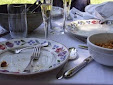
A few months ago, my husband and I had that rare and precious thing: the spontaneous offer of a babysitter. We decided to go out for dinner. We lucked upon the last table at a lively restaurant and shared a fantastic meal, with wine to match each course.

As the evening drew to a close, I sat there turning my glass in my hand and reflecting on how well we have eaten over the years. Before we had children, we dined out several times a week. Since then, we have visited Europe twice with young kids and eaten our way around Italy, Germany and even, surprisingly deliciously, Great Britain, while at home we buy nectarines, mangoes, avocadoes and all sorts of other foods that neither of us had much as children; they were far too expensive back then.

Flooded with gratitude, I said to my husband, “I have had so many good things to eat in my lifetime, it really wouldn’t matter if I never ate another decent meal again.”

As is the way of fate, a couple of days after I made this claim I went to a natural therapist to try and tackle years of fatigue and constant illness, and in particular the development of debilitating arthritis; and, as I wrote in last quarter’s Zadok Perspectives, I was immediately placed on a very restrictive diet for four months (no sugar, gluten, fruit, dairy, alcohol or caffeine), with the additional caution that I should strictly limit my intake of these foods for the rest of my life.

The timing was impeccable. I had just made a big claim about food; here was my opportunity to test it. In any case, I was so desperate to feel better that I quickly adopted, and have largely stuck to, the diet; but I soon found myself wondering what to do about eating with others. How would we celebrate a birthday if I couldn’t eat cake? What would we have for a friendly afternoon tea if I wasn’t eating scones? Who would come for dinner if I didn’t make dessert or pour out the wine?

Clearly, hospitality wasn’t going to work if the sweetest thing on offer was a carrot stick. On reflection, however, I realised that the restrictive diet was only about eating. I could still cook whatever I liked; whether or not I ate the food was a separate issue. So I stuck to my usual pattern of whipping up banana loaves on Mondays, when Grandpa comes to visit; baking cakes on birthdays and grumpy days; and making cookies to take to friends.

I thought I might resent cooking food that I could not eat myself, but I also thought it would be a good test of my generosity. To my surprise, however, far from resenting the situation, I have discovered that I still love to make special things. Previously, I hadn’t realised just how much the act of preparing and offering food gives me pleasure; I had thought a great deal of the pleasure was in the eating. But seeing friends and family savour and relish what I have cooked, and watching them grow expansive after the second glass of wine, makes me tremendously happy; and, as my taste buds shift to a more savoury palate, my desire to eat the food myself grows less and less.

It’s the opposite of most advertising messages, which encourage us to satisfy ourselves and make ourselves happy because, we’re told, we’re worth it. Instead, as I chomp my way through yet another handful of nuts or celery sticks, or perhaps crunch into some rice crackers which are, I admit, growing rather tiresome, I recall that others are worth it; and in seeing them respond to the loving care that is communicated through a slice of cake or a basket of scones or perhaps a pot of soup I cannot eat, I find myself expansively happy and deeply satisfied, having never even taken a bite.

PS - For those who are curious, a year or so later I am now drinking wine (you gotta live) and caffeine (which helped me limp through the debilitating fatigue I experienced during a month of eating gluten prior to a test for coeliac disease). I aim to wean myself off caffeine again when things have settled down. I still eat very little cane sugar, fruit, gluten and cow's milk.

Tuesday, December 18, 2012

The Silence Speaks Again: Next Year


Next year, I've been invited to undertake some postgraduate research in a field I am passionate about. I am over the moon. Well, part of me is. That part of me has spent hours reading in the area months before I plan to enrol. That part hears my potential supervisor saying that something I have already written would make a fine start to a thesis. That part has already joined a research group, and met some delightful people doing interesting things. That part of me can confidently say, I know how to structure my time; I know how to write; I am very self-motivated: I can certainly do this.

That part of me can also recognise the great gift of the invitation. After nine years at home with kids, I am more than a little bored. I still have fifteen months before my youngest starts school, and while I am happy to be home with her for some of it, the thought of staying home full time until then is, to put it bluntly, excruciating.

I had been wondering what I could add to next year's mix – more volunteer work? more writing? a course? – when out of the blue I was invited to study. It's everything I could want: a reason to read and write, mentors asking difficult questions and pointing me in new directions, training in how to structure a large piece of work. The project is perfect, the timing is perfect: what a gift! I should be over the moon – and part of me is.

But there's another part of me, too. It's the part which is dragging her feet on the enrolment; which worries about how to fit it all in with a little girl still at home; which looks at the PhD students she knows and wonders how on earth she thinks she can do it; which gets a churning stomach at the very thought. And now that the initial excitement of the invitation has worn off, this part is making itself heard. It is so convincing that I have wondered about turning down the invitation.

I've been going round in circles for weeks. Finally, I decided to sit with the idea in silence, that infinite scary place where things bubble up that are difficult to hear. So I sat, took a deep breath, exhaled, and began to listen. My mind chattered on. I thought about dinner and a new idea for packed lunches, and put the thoughts on a mental shelf. I wondered about a sick friend, and put her on the shelf, too. I had an image of me teaching at a tertiary level. I wondered where that lunatic idea came from, and as I was putting it up next to the food and the friend, a voice came to me clear as a bell: You're almost forty, and you still believe you are not capable of such work.

I burst into tears; as usual the silence spoke truth. I don't believe I can do it. Yet I'm hardly an idiot. I love ideas and people and talking and writing. Most of my friends have higher degrees, more than a few are academics, and among them I usually hold my own. Of course I should be able to study and write and teach at that level.

Even so, the internal soundtrack which says I'm not competent is still very powerful, and it's been reinforced by decisions we made about how to raise our children. I chose to stay home and suddenly I'm a decade out of the workforce. Everyone else has forged ahead, and I'm left with a head full of ideas, reasonably happy kids – and an incredible lack of confidence. Sure, I'm getting pretty good at the washing and shopping, cooking and cleaning. At some deep level, however, I'm not convinced I could do much more.

Now, being competent at domestic tasks and child raising is no shame. These are important things, necessary to a family's health and wellbeing, and there is dignity in sustaining one's household. In and of itself, it is good work. Yet other work is good, too. And here am I invited, by what feels like the right person and at what feels like the right time, to engage in something more, and I am reluctant. I am sure I cannot do it, and I want to opt out.

Thanks to the silence, however, I now recognise my reluctance for what it is: old soundtracks and fear. And so, since a life ruled by such masters is no life at all, I am going to have to listen to the other voices, the ones which recognise what I might be able to do and urge me to give it a go.

As for what I want to do? Well, the silence showed me an image of me teaching. Perhaps it was a clue.

Tuesday, December 11, 2012

New House, New Neighbours


Somewhat oddly for a blog devoted to the idea of home, I haven't mentioned an enormous change in my own home life. Events happened too quickly for me to assimilate and write about them before now, but this is the news: we have moved. Yes, moved.

I know this comes as a shock to many who know us; it certainly wasn't something we had planned to do. So how did it come about?

I have written before about our street, and how I have struggled to make much headway with the neighbours. I have one excellent neighbour; one neighbour who is civil when we bump into each other on the street; and that is the extent of it. Everyone else is emotionally absent. I say, rather brightly, 'hello!' and the other neighbours duck their heads and avoid my eyes – even the ones with kids.

They don't seem to talk with each other, either. I have come up with all sorts of justifications for their behaviour; I have wondered if there's something wrong with me; finally, I have decided they are just city dwellers – or rude.

Meanwhile, for years we'd floated the idea of buying neighbouring houses with close friends, but it never panned out. It was something I had given up on; and when I gave up, I found the energy to fix our own house. In the last twelve months I have had the eternal leak in the roof fixed; painted the house; and even put in a big veggie garden.

And like the couples I know who relinquished the dream of conceiving a child and adopted, only to fall pregnant minutes later, once the garden was finished a house came up for sale in our friends' street. We looked at it out of curiosity, thinking there was no way we'd move – especially now our roof was fixed and the garden done.

But we fell in love. The house was old, ramshackle and airy, with roses in the front and fruit trees out the back. We looked again with family and my father said, 'Now is the time to decide what you value more highly: your nicely renovated house and garden, or friendship.' Nothing like putting our values on the line, dad.

We looked a third time. I wailed to one friend, 'surely I am supposed to develop relationships with the neighbours that I have, not become neighbours with my friends'. She pointed out that I had tried for over a decade in my street, and encouraged me to move on.

My husband and I worried and fretted and moaned for a fortnight, going back and forth. It was closer to some friends, further from others. It was smaller than our house, and not in such great condition. Our fridge would never fit. We could walk to the library and pool, but no longer to our favourite shops. Perhaps the floor plan would work better for us? Every night we talked and teetered back and forth like one of those wobble toys. Then the house went to early auction and, hearts thumping wildly, we bought it.

We moved just over a week ago. Within two days I had met eleven neighbours, not counting the friends I already knew. The neighbours on one side have a very large extended family which convenes regularly for meals. During last week's gathering, my kids climbed up the fence and peered over at the party, had a good chat with whoever was down there, and were handed fragrant shishkebabs over the fence. (Rather irritatingly, although they usually gag and moan at anything new, especially meat, they demolished them and begged for more.)

The kids and I also spent an hour with the family across the street, drinking tea (me) and climbing on the cubby house roof (the kids). And we've been invited in by two other households. Meanwhile, we've eaten with our longstanding friends twice in a week, meaning we've each had a night off cooking and our kids have run around very happily together. And our friend's son, an only child, has come over after school.

Boy, is this street different. I've spent more time in other people's kitchens after a week here than after a decade in the old; I already know more people's names.

When I looked at the new house, I felt shaky. I was uncomfortable with the idea of change; I didn't want to pack up my house; everything was changing focus and it felt very difficult. And yet for many reasons, moving felt like the right thing to do. Our kids loved the house and wanted to be closer to their friends; we loved the house and wanted to be closer to our friends; and, although it is further from the city, the new house is more convenient for almost every aspect of our family's life.

An astute friend suggested that my collywobbles were like birth pangs, overwhelming and painful, but not to be confused with real doubts. Instead, he thought they were the harbinger of new life to come. A week after the move, I am sure he was right. We fit with this house very, very well; we have roses in the garden; and, without a doubt, we have neighbours.

Saturday, December 1, 2012

Christmas Shopping

Christmas looms and I'm beginning to worry about presents. Our house is already full of stuff: dolls and blocks and textas and jigsaws and marbles and puppets and books. We have so much more than enough. We certainly don't need another pile of toys; it's just more to pick up at the end of the day.

I hear other parents talking, even complaining, about the latest electronic gadget or plastic toy they've just bought their kids. Because I've never quite worked out how the giving of expensive and unnecessary things made for the most part in appalling conditions relates to the birth of a man who said 'Blessed are the poor', I refuse to play this game, and resent the pressure to acquire the latest thing. Even so, failing to participate in the excess can make me feel mean: my kids are kids, after all. They like to unwrap things; they like presents.

Stepping off the consumer treadmill is easy enough with adults. I make jam, put together a mix tape, or pass on a choice op shop plate to someone who likes a bit of retro. Yet my kids are another story. Do I deprive them of the overabundance that they see in other families? Do I withhold expensive gifts from them and stand my ground? Well, to some extent, yes – especially while they're young. And yet I am also of my culture; I like to give gifts. The difficulty is deciding what.

It seems to me that for the giving to be any kind of celebration, then the things I give must be celebratory – and this means that there's no guilt attached. So I'll avoid items made in unregulated factories and sweatshops wherever possible; avoid ostentatious status symbols; and avoid useless things that will wear out quickly. More positively, I'll look for things which are practical, second hand, fair trade, homemade, or charitable, and which together give a sense of that most intangible of concepts, 'enough'.

When I think back to earlier Christmases and what my daughters have most enjoyed, I recall them running around a park where we have held Christmas lunch. A friend had given them new umbrellas, and they spent the afternoon dancing around spinning their brollies; holding them up and pretending it was raining; and wandering off to the far reaches of the park together, chatting under their portable shade. One brolly had an elephant trunk; another, panda ears, and they hid behind bushes, holding them up and roaring as if wild beasts were lurking. Those umbrellas provided hours of fun; and years later are still in regular use.

Remembering this, I know my girls will survive without Wii and a DS, even if they want them. I can stand firm. So Christmas for my three will be as usual: a few trinkets from the kinder fete to fill our foot-not-pillow-sized stockings: pretty hair bands, a nice pen, a little notebook. I'll get them a new fair trade hat and a pair of bathers each to replace the faded things they've grown out of. I'll get three favourite books, borrowed time and again from the library and now ours to keep; and buy some songs online and burn a new CD with music we'll all enjoy. Together, we'll choose a few gifts from a community development agency: a goat, perhaps, or some chickens.

And so each child will get bathers, a hat, a book, a hair band, a theoretical goat and a bit of dancing round the lounge room: practical, fair trade, homemade, charitable, joyful. To celebrate the birth of a man two thousand years ago who loved kids and told us to look out for the poor, it may still be an imperfect list, but for three little girls living in the here and now, it feels just about right.

***

Can't think of a gift?

*Pass on an unused treasure (lamp, book, rug, canisters, wine glasses, leather jacket, bracelet, platter).

*Make something (frame a photo, bottle some chutney, get baking, collate a recipe book).

*Give a plant (pot up lavender, pelargonium or daisy cuttings, or hen and chicks, or sow seed).

*Spend thoughtfully (dedicate a gift to charity, draw names instead of buying for everyone in a family, shop second hand, buy an edible fair trade gift (coffee or chocolate), buy something necessary but fun (bathers for kids, organic fair trade underpants for adults!)) For a list of fair trade places to shop which I have used, click here.

For more good ideas on how to celebrate Christmas without the ostentatious consumerism, visit buynothingchristmas.org.

 
(Of course, you could just get them a really cool cardboard box; it can be a shop, a car, a cubby, or even a little bed!)

Friday, November 23, 2012

Response: The Idle Parent

The Idle Parent: Why Less Means More When Raising Kids

The kids and I were at the local pool, playing ring-a-rosy. I was having a ball pulling them underwater; judging from their giggles and shrieks, they were having a ball too. Behind us some older kids were fooling around, aged maybe nine, ten and eleven. Above us strode an anxious lined middle class mother, watching them like a hawk and shouting an instruction every few seconds. ‘Stop that! Leave him alone! Go left! Watch out! Be careful! Move to the right!’. On and on and on it went.

I felt myself cringing at her, and then at myself as I rebuked my six-year-old for launching herself into a group of toddlers. ‘For heaven’s sake,’ I wanted to shout – both at her and myself – , ‘leave them alone!’

How can kids enjoy themselves when their every move is noticed and critiqued? How can parents enjoy themselves when they are convinced that every move their kids make will result in disaster? And yet that is the tone of so much middle-class parenting, and so much parenting material. For the most part I avoid parenting books. Sanctimonious and puritanical things, I want nothing of them. But at right angles to the essay section of my local bookshop is the parenting shelf; and catching my eye the other week was The Idle Parent.

What a title! It sang out to me. I have three kids, aged nine, six and four, and I just can’t be bothered being a proper energetically hovering middle class parent like the woman at the pool. As all the other mums rush their kids off to karate / jazz ballet / Chinese / drawing / whatever, I certainly do feel idle; even so, I don’t have the energy or interest to do likewise. The thought of watching some six-year-old learn a dance move makes me want to scream with boredom; worse, standing over them as they leap about the local swimming pool makes me want to slit my throat. I want to fool around in the pool myself, or I want to read a book; either way, moderating their fun is not my idea of a good time. So I picked up The Idle Parent, and devoured it overnight.

The book’s thesis is simple: Leave them alone! We are not kids, and kids are not adults. Our interests only sometimes overlap. So, suggests the author, the simplest recipe for a healthy happy family life is to give your kids the freedom to do their thing while you go and do your thing. Be there when they need you, but don’t hover. Just let them be. His ideal parenting situation is a large field, many kids romping at one end and many parents drinking beer at the other. Everyone’s safe, and everyone’s happy!

Such a scenario brought a big smile to my face, because I have often thought that my ideal parenting situation is a house party, with twenty kids running around and twenty adults drinking wine and talking their heads off. My kids tend to agree, which is why they beg for such events. Who are you inviting over? they ask most Saturdays, There must be someone!

(For that matter, our other favourite parenting environment is a large field at a friend’s block, as long as we have a couple of extra kids with us. The kids run down the hill and over the next ridge, and we can talk, enjoy the view and inspect the new growth while they’re gone. Last time the horde came charging back up the hill, screeching and laughing themselves silly, dangling leeches from the ends of their fingers and waggling them about. It was hilarious.)

By now any non-parents must be rolling their eyes; do we really need a book to be told to leave the kids alone, even if it is to get sucked by leeches? But those among us with children know just how hard it is. Our culture highly values present and attentive parents, lest little Johnny have his fragile ego squashed because Mummy is more interested in a book than in him, or lest little Cindy have her hopes of being a professional ballerina dashed because Mummy couldn’t be bothered with dancing lessons. Even the author of one of the more interesting recent books about child raising, Last Child in the Woods, which is about the urgent need to get children back in touch with the natural world, admits that he never lets his sons out of sight when they’re hiking. (When I read that, I didn’t know whether to throw the book across the room, or cry.)

In that light, I am a wicked mummy. I have friends and interests that have nothing to do with my kids; I remind the kids about snakes then let them roam through field and forest; and so it is a great relief to read a book which backs up my more carefree approach.

Of course, Hodkingson doesn’t advocate absolute freedom. He has strong ideas about what is and is not helpful as kids explore the world. Television gets the thumbs down, as do plastic toys and having too much stuff; inside isn’t the best place; and neat clean tidy places aren’t ideal, either. He argues kids need space to roam, lots of access to trees, bushes and wild spaces, and things to make stuff with. Good books, wrestling on the floor, a bit of dirt and mess... it all sounds about right to me. The result of such an approach is resilient, creative, competent children (and parents) who are resistant to the lies of consumerism.

The book draws from a broad range of thinkers, from John Locke, Rousseau and DH Lawrence to AS Neill (Summerhill School); ideas from more recent authors, including Skenazy (Free Range Kids) and Louv also surface. The synthesis is cheerful, intelligent and convincing. Above all, I appreciate that it is not just about kids (and therefore about what parents should do (and fail to do) in raising them); instead, The Idle Parent is really about families. Hodgkinson asks good questions about what parents want from life, and encourages the reader to critique his or her own approach, and to recognise and critique the at times suffocating limitations of the dominant culture.

For example, he asks what is enough – do both parents need to work full time or could they both be home with kids more? Why do we live where we do: could we live elsewhere and pay less rent or mortgage? Could we live in a smaller house closer to work and spend less time commuting? What do we spend our money on, and why – do kids really need or want manicured houses, expensive holidays, amusement parks and fancy toys, or are they consumerist furphies? What do we enjoy doing as a family, and what do we hate doing together? Do we enjoy holidaying together, or are there times when separate vacations would be more restorative? Do we need more adults around to contribute to family life, and if so, who can we call on: friends, family, paid employees? In short, he questions how we adults constrain our lives (particularly with regards to happiness) and how we might liberate ourselves, using a refreshingly utilitarian approach.

It’s a lovely book and terrifically opinionated. It opens with a manifesto ‘We pledge to leave our children alone / We reject the rampant consumerism that invades our children’s lives from the moment they are born / We drink alcohol without guilt / We reject the inner Puritan...’, and follows with chapters including ‘Seek not Perfection’, ‘The Myth of Toys’, ‘Down with School’, and ‘Let Us Sleep’, familiar territory for most parents. Best of all, he offers no one-size-fits-all solution, but encourages each family to find what works – or, in the words of the Manifesto, ‘There are many paths’. Hodgkinson has strong opinions about what doesn’t work – long hours at work, large mortgages, too many toys and bits of plastic, guilt – and many suggestions about what could.

I happened to go on a family holiday right after reading the book. I was going to spend the first week largely alone with my girls in a beach house twenty minutes’ walk from town, with no car. It had the potential to be fantastic, which is why I had organised it so; but it also had the potential to collapse into nightmare. I’m not overly fond of the beach. I’ve had little kids for so long that it feels like I spend my whole time hovering there. I don’t get to sit, and I don’t get to swim; and I don’t like building sand castles or helping anyone else do so, either. But this time, I was determined it would be different. The kids are a bit older, the beach was on a shallow bay, and I was going to be Idle. The holiday wasn’t going to be just for my kids – I was going to have a holiday too.

Day One. Resolve and book firmly in hand I sat in the sand, ignored my girls, and read while they built sandcastles and splashed in the shallows. Nobody drowned. I was so relaxed that after fifty pages I shut my book and went and dreamily dug a moat out of pleasure, not duty. My girls were delighted. We went home for lunch, then I taught them how to do the dishes, explaining that I would do the cooking and the dinner dishes and this was a fair division of labour. When they kicked up, I pointed out I would take them back to the beach after the dishes were done, then walked out. I lay on my bed and read my novel; and after a while I heard the sounds of them washing, drying and putting things away. I also heard them make up a dishes song that lasted them through every batch of dishes for the entire two week holiday. And then I heard them each find a book and a quiet corner and read too, for an hour. Bliss.

So each day went. They did stuff they wanted to do; they did a bit of housework; I did stuff I wanted to do; I did a bit of housework; and sometimes we overlapped. I didn’t shout at them or watch over them closely; and because I was reading and dozing and feeling relaxed, when I did spend time with them it wasn’t a duty but a pleasure – and so it was fun.

And this, I think, is Hodgkinson’s point. We are born free, and everywhere we are in chains. Parenting is a prime example of this; it sometimes feels impossible to have a conversation about parenting without whinging or listening to others whinge. But Hodgkinson reminds us that we in the Western world are free. We choose to partner and we choose to have children; we choose where we live and how we work; and so on. As free adults we should take responsibility for our choices, stop whining about them, and start finding ways to enjoy ourselves while we and the kids co-exist. And if we do so, we will all find ourselves having a lot more fun.

With his words (‘I am free! We are all free! I am being Idle!!’) ringing in my ears I found many ways to enjoy myself that holiday. I read a dozen books, and we all caught up on a heap of Japanese anime. My legs lost their ghostly winter pallor. The kids learned French cricket and how to dig for crabs, catch, cook and eat a fish, and wash the dishes afterwards. There was very little yelling by anyone. I came home renewed and ready to step even further back as a parent. It mostly works, and that’s good enough. Oh idle me!

Free Range Kids: How to Raise Safe, Self-Reliant Children (Without Going Nuts with Worry) Last Child in the Woods: Saving Our Childern from Nature-deficit Disorder Summerhill School

Thursday, November 15, 2012

Just leave them to it!

 
I hate to break it to you, but there is no right way for a three-year-old to colour in and cut out a picture of a shoe. I know you’re trying very hard to be the best mummy that you can be, but let it go. Just let it go.

At the library today I watched you at story time. My daughter was there too, listening and singing along. When they passed out the activity, she collected a pack, plonked herself down, chose some crayons, and coloured in her shoe just the way she wanted. Then she picked up the safety scissors, stuck out her tongue, and snip snip snipped her way around the edge. While she was occupied I sent a few text messages, sitting alone because you were sitting on the floor, showing your kid how to do it properly.

My daughter finished and grinned. It wasn’t the world’s neatest colouring in, and it wasn’t the slickest bit of cutting out. But she was happy. She picked up her shoe, and brought it over to me. She asked me to thread in the frayed lace, which really was too tricky for her, so I did. 'Good,' she said. Then she stuck her shoe in our bag and chose a couple of books, and we read some stories.

Meanwhile you were still on the floor. You were making sure the colours were blocked in nicely, checking with your child which colours you should use. And your child was looking at anything but the shoe that you had taken for yourself. You kept trying to bring your child’s attention back to the activity, so they did a quick scribble to feign interest, but their heart wasn’t in it.

Your kid glimpsed the scissors, and picked them up. ‘No!’ you said, ‘sharp!’. But I can tell you that those scissors don’t cut fingers. They are safety scissors, for little people to cut paper. It takes real dexterity and determination to use them to cut fingers; and your child appears to have had so little practice that there is no fear of that. I watched you pick up the scissors and cut out the picture, very neatly; you’re almost 40, and you’re getting pretty good at it. You deserve a gold star!

But your kid was bored – and it is not your kid’s shoe. You took it away from them the moment you picked up a crayon. You might stick it on the fridge for a week or two, but your kid won’t be showing it to anyone. They know it was your work.

Trust me, there really is no right way to colour in. If your kid needs to practice their fine motor skills, they might try and colour in very neatly. If your kid is feeling joyful, they might cover the drawing with bright swirls. If they’re grumpy, they might scribble over it in black, or ignore the activity altogether. They might turn the paper over and draw a robot on the blank side; they might take the scissors and cut the paper into a thousand little bits; they might snip a fringe into the side of the sheet. Or they might ask to go for a walk. But you will never know if you don’t give them freedom.

This activity wasn’t a test. Your child won’t be getting into law school because their shoe was beautifully coloured in and cut out at the local library when they were three. In fact I suspect your efforts were counterproductive. Your kid learned some things today. They didn’t learn what colours they like; they didn’t find out what happens when they swirl colours together; they didn’t get to practice their fine motor skills; they didn’t make a choice about what they wanted to do, or how. But they learned to get with the program. They discovered that there is only one way to do an activity; they saw that it is best left to 40 year olds; they were taught to be an audience; and they were shown that they can’t be trusted with scissors.

If you want your kids to have any skills, let alone creativity, you need to let them do stuff. Kids have to do a thousand drawings and make a thousand cuts to learn how their fingers work and how paper and crayons and scissors interact. They need to try lots of things to work out what they like to do. It’s not just drawing and cutting. Kids need practice at everything. They need to spread too much butter on their bread and pour the milk to overflowing and put too much cereal in the bowl if they are going to learn to make their own breakfast. I’m tired of eight year olds coming to my house who can’t hold a butter knife or make their own sandwich. So let your kids do their own drawings. Let them make their breakfast and their lunch, put away the dishes, pack up the crayons, and be useful. Let them make messes and mistakes. They will thrive.

And so will you - because aren’t you bored? Aren’t you tired of making their lunch and clearing up their mess? Do you really want to spend your morning colouring in and cutting out, trying to make your kid interested in something that you yourself find tedious? Your three year old could make it interesting, if you let them. Left alone to colour and cut, they will do something you really don’t expect; often, it will be delightful.

Even better, they can pick up their toys and put them away; they can spread a sandwich; they make their own beds. They just need practice, which they will never get while you do everything for them. So let it all go, just let it all go. And if you do, and let your child work things out, you could sit in the library at the edge of the circle, and have a good chat with me.

Centipede's 100 Shoes (This story from today made me laugh until I had tears in my eyes. Thanks to Brunswick Library storytime for introducing it to us all!)

Saturday, November 10, 2012

A little humiliation is good for the soul

I was on my old bike, pulling a trailer heavy with child and labouring uphill when I saw that the council in its wisdom was watering the bike path. Eight rotating sprinklers ensured that two sections of path were being soaked at any given time; yet a sudden veer into the grass would take me straight into another line of sprinklers. The only way was through. I tried to time it to wet only my calves but misjudged a sprinkler’s rotation, and was promptly sodden from my crotch to my knees. I had to ride home looking for all the world like I had wet my pants; even my underwear was soaked.

Some mystics suggest that a little humiliation is good for the soul. It reminds one of one’s place in the world; it punctures one’s pretensions; it keeps one humble.

Lucky me – I am humiliated all the time. Like so many parents, I have generally relied on young children for my daily dose. It began at childbirth – the little poo that came out with the baby – and was quickly matched by the baby’s far greater poonami in a public place that shot up to her shoulder blades and smeared over my hands as I discreetly tried to clean it up. There were so many little episodes: the pregnant woman’s desperate need to pee seventeen times in an hour and the toddler who absolutely must piddle in the gutter right now; the mother screaming at the three year old and the three year old screaming at the supermarket. My oldest daughter was two when she first asked me to ‘dress more stylish’; how humiliating, to be chastened for one’s fashion sense by a person who had recently dangled her plaits in the toilet. I might have looked more chic had I not gone out so many times with a smear of snot on my black-clad shoulder, unseen until I left the house.

It reminds me of a local mum, when she and her husband first left the kids overnight. For the first time in years, she wore a strapless dress and dined at an elegant restaurant with friends. Halfway through the meal, someone pointed to her bare shoulder and asked, ‘What’s that?’. She turned and discovered a parting gift from her children: a louse. Humiliations galore!

Of course, these are only the physical embarrassments that children bring. More toxic, there have been times when my behaviour has been so abominable that I have felt sick with shame. My frustration, my filthy temper, even my violence – and always over the little things – have shown me how frail I am. Without enough sleep, without food at very regular intervals, without a bit of peace and quiet, I am absolutely unbearable – and without children, I might not have learned just how low I can go.

So I am grateful to the kids for the small humiliations, and the ways they have shown me up; and I am grateful to have learned that despite it all, I am loved. Yet the kids are growing up. I get more sleep, less snot and have better learned how to regulate my mood; and the humiliations seem to have dwindled. Am I at risk of being overtaken by pride?

On reflection, whether it’s wobbling on my bicycle and falling in slow motion into the gutter (my six year old laughed so hard she was nearly sick); or eating a rare candy, losing my temper, and having my eight year old ask quietly, ‘Have you eaten sugar?’ – well, I find I am quite able to humiliate myself without the children’s help.

It takes very little to tip me over: a steep camber on a road, a teaspoon of sugar on an empty stomach; clearly, I am unbalanced. It’s embarrassing, but what’s a girl to do other than look in the mirror, recognise the fact, and sigh?

A good humiliation used to make me feel physically ill; I suspect it was because it was so challenging. I had a puffed up ego but was empty inside; to burst the bubble was terrifying. These days, I feel more grounded, more humble. I am beginning to know who I am. I’m no giant, just a little person pottering along close to the earth; I have less distance to fall.

And so humiliation is losing its power over me. These days, I tend to see it as an opportunity. If I am humiliated by my own behaviour, it’s a chance to apologise, and learn. If I am humiliated by something that happened to me, it’s a chance to let go of my sense of self-importance: who am I that I can’t look silly sometimes? Often, I even find myself laughing.

A humble person can’t really be humiliated; and by taking the humiliations on board and letting them break through my pretences bit by bit, I am slowly getting there. Even wet from the crotch down, I wasn’t really embarrassed; instead, I imagined with delight the gales of laughter as I would tell a particular friend. So I think the ancients were right: a little humiliation has been good for my soul.

I was out walking, pondering these things and thinking I should write them down, when a bird anointed my forehead with crap.

(Disclaimer: Of course, this doesn’t mean that humiliating others is ever okay, nor does it mean that one should remain in an abusive relationship where humiliation is the norm. On the one hand, the world provides plenty of humiliating moments without our help; on the other, we do not need to seek out humiliations in some kind of cosmic self-flagellation. But those that do come our way... well, we can use them.)

The Princess Bride (Deluxe Edition) "Humiliations galore!"
Related Posts Plugin for WordPress, Blogger...